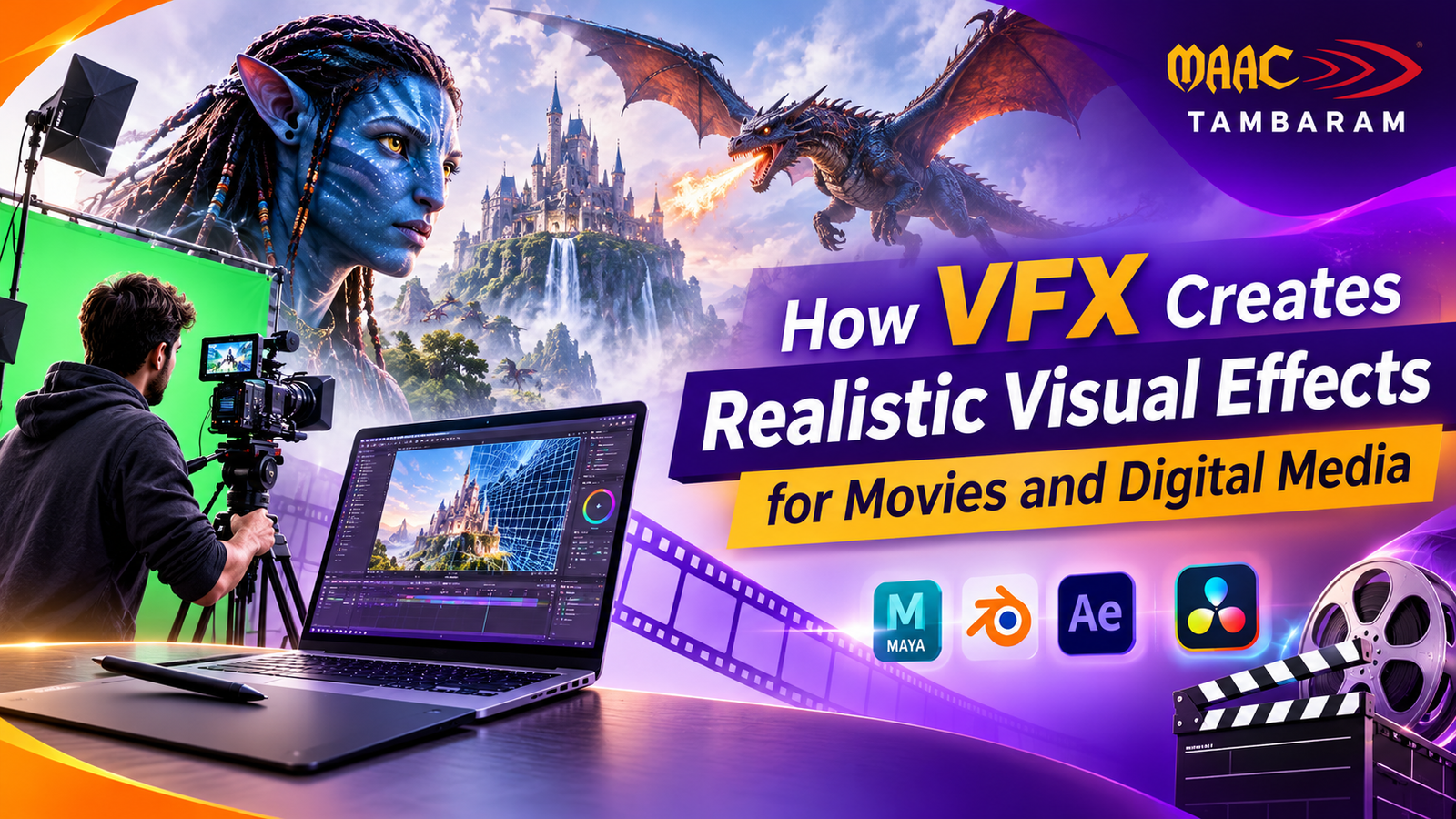
Have you ever wondered how filmmakers create breathtaking action sequences, imaginary worlds, flying superheroes, or realistic creatures on screen? Many of these impressive visuals are created using Visual Effects (VFX), a technology that combines creativity, computer graphics, and digital techniques to bring extraordinary ideas to life.
Today, VFX has become an important part of the entertainment industry. From Hollywood movies and animated films to advertisements, television shows, and digital content, visual effects help creators produce scenes that would otherwise be difficult, expensive, or impossible to capture in real life.
As demand for visually engaging content grows, learning VFX skills can open doors to exciting creative career opportunities. Students interested in this creative field often search for the best VFX course online to develop their technical knowledge and understand professional visual effects production. Exploring specialised VFX training can be a valuable step towards building a creative career.
What Is VFX and How Does It Work?
Visual Effects, commonly known as VFX, refers to the process of creating or enhancing images and scenes using digital technology. It allows filmmakers and digital artists to combine real-world footage with computer-generated elements to create realistic visual experiences.
For example, a movie scene showing a massive explosion, a futuristic city, or a character interacting with a digital creature may involve several VFX techniques. Artists carefully combine live-action footage, digital models, lighting, textures, and visual effects to make everything appear natural.
VFX production involves multiple stages, including planning, shooting, compositing, rendering, and final editing. Each stage contributes to creating a visually convincing result.
How VFX Creates Realistic Visual Effects in Movies
Modern filmmaking uses different visual effects techniques to transform ordinary footage into extraordinary cinematic experiences.
1. Green Screen and Chroma Key Technology
Green screen technology allows filmmakers to replace a specific background with digitally created environments. Actors can perform in a studio while VFX artists add mountains, cities, outer space, or other locations during post-production.
This technique is widely used in action movies, fantasy films, advertisements, and television productions.
2. 3D Modelling and Animation
The practice of employing specialized software to create digital objects, characters, buildings, and surroundings is known as 3D modeling.
VFX artists use tools such as Autodesk Maya and Blender to develop detailed 3D models. These models can be animated and integrated into live-action scenes to create realistic interactions.
For example, digital creatures, vehicles, futuristic buildings, and imaginary characters are often developed through 3D modelling and animation.
3. Motion Tracking
Motion tracking helps VFX artists understand the movement of cameras or objects within recorded footage. This information allows digital elements to follow the same movement as the original scene.
It is especially useful when adding computer-generated objects, characters, or environmental effects to moving shots.
4. Digital Compositing
Compositing is one of the most important stages of VFX production. It involves combining multiple visual elements into a single final image or video.
Artists combine background footage, 3D models, lighting effects, shadows, and other visual elements to create a seamless scene.
5. CGI and Realistic Lighting
Computer-Generated Imagery (CGI) is used to create digital characters, objects, environments, and visual effects.
Realistic lighting, shadows, reflections, and textures are essential for making CGI elements look natural. VFX artists carefully adjust these details so that digital objects match the lighting conditions of the original footage.
The Role of VFX in Digital Media
VFX is no longer limited to cinema and television. It has become an important creative tool across several digital industries.
VFX in Movies and Web Series
Filmmakers use visual effects to create realistic action sequences, fantasy environments, science-fiction worlds, and complex cinematic scenes.
VFX in Advertising
Brands use visual effects to create attractive advertisements, product demonstrations, and promotional videos. Digital enhancements help businesses present their products in creative and engaging ways.
VFX in Gaming
The gaming industry uses 3D assets, realistic environments, character animation, and visual effects to create immersive gaming experiences.
VFX in Social Media and Digital Content
Digital creators use visual effects in promotional videos, short films, music videos, and social media content. Creative transitions, motion graphics, background replacement, and digital enhancements help make content more engaging.
Popular Software Used in VFX Production
Learning industry-relevant software is an important part of developing professional VFX skills.
Autodesk Maya
Autodesk Maya is widely used for 3D modelling, character animation, rigging, and visual effects production.
Blender
Blender is a versatile 3D creation tool used for modelling, animation, rendering, and visual effects.
Adobe After Effects
Adobe After Effects is commonly used for motion graphics, compositing, animation, and visual effects.
Compositing Software
Compositing tools help artists combine different visual elements, correct colours, manage layers, and create seamless final scenes.
How to Choose the Best VFX Course Online?
Choosing the best vfx course online requires understanding what skills and practical knowledge you want to develop. A good VFX learning programme should cover both creative fundamentals and technical production techniques.
Before selecting a course, consider the following factors.
1. Check the Course Curriculum
Look for a curriculum that introduces important VFX concepts such as 3D modelling, animation, compositing, CGI, lighting, and rendering.
2. Learn Industry-Relevant Software
Choose a programme that provides exposure to professional creative software such as Autodesk Maya, Blender, and Adobe After Effects.
3. Focus on Practical Projects
Practical assignments help students understand how visual effects are created in real production environments. Working on projects also helps build a portfolio.
4. Understand the Learning Support
Mentorship, project guidance, feedback, and structured learning resources can help students improve their technical and creative abilities.
5. Explore Career Opportunities
Understand how the course prepares you for different roles, including VFX artist, compositor, 3D modeller, lighting artist, and animation professional.
Comparing these factors can help students identify a suitable learning programme based on their interests and career goals.
Skills Required to Build a Career in VFX
A successful VFX artist needs a combination of creative thinking and technical knowledge. Artists benefit from an understanding of color, lighting, composition, perspective, and visual narrative to create realistic scenes.
Knowledge of 3D modelling, animation, compositing, rendering, and editing software is also valuable. Attention to detail and problem-solving abilities are equally important because even small visual inconsistencies can affect the final output.
Developing these skills through structured training and practical projects can help aspiring artists understand professional production workflows.
Career Opportunities After Learning VFX
The growth of films, OTT platforms, gaming, advertising, and digital entertainment has increased the demand for creative visual content.
Students interested in animation and VFX can explore different career paths depending on their interests and technical strengths.
A VFX artist works on creating and enhancing digital visuals for movies, advertisements, and other media projects. A 3D modeller develops digital characters, objects, and environments. A compositor combines different visual elements into seamless scenes.
Other career opportunities include 3D animator, motion graphics artist, lighting artist, texture artist, rotoscoping artist, and video editing professional.
Building a strong portfolio with practical projects can help students demonstrate their creative abilities to potential employers.
Why Choose Professional VFX Training at MAAC Tambaram?
Learning visual effects requires more than understanding software tools. Students need practical exposure to different production techniques, creative workflows, and industry-related projects.
MAAC Tambaram offers specialised animation and visual effects learning programmes designed to develop creative and technical skills.
Students can explore programmes such as ADVFX PLUS, VFX PLUS, and Compositing & Editing Plus, which introduce different areas of digital production and visual storytelling.
With exposure to 3D animation, compositing, editing, and other creative techniques, students can develop the knowledge required to explore opportunities in the animation and visual effects industry.
Whether you are researching the best vfx course online or exploring professional VFX training programmes, understanding the curriculum, software, and practical learning opportunities is essential before making a decision.
The Future of VFX in Movies and Digital Entertainment
The future of VFX is closely connected to advancements in digital technology. Real-time rendering, virtual production, artificial intelligence, and advanced 3D techniques are changing how visual content is created.
Filmmakers are increasingly exploring new production methods to create realistic environments and interactive cinematic experiences. Gaming companies and advertising agencies are also adopting advanced visual technologies to improve digital storytelling.
As these technologies continue to develop, creative professionals with strong foundations in VFX, animation, and digital production will have opportunities to explore different areas of the entertainment industry.
For students interested in creative technology, developing VFX skills today can be a valuable investment in their future.
Start Your Creative Journey with MAAC Tambaram
Visual effects have transformed the way movies, advertisements, games, and digital media are created. From realistic CGI characters to impressive cinematic environments, VFX combines artistic creativity with advanced technology.
If you are interested in building a career in digital entertainment, exploring professional VFX training can be a great starting point.
MAAC Tambaram provides specialised learning opportunities in animation, visual effects, compositing, and digital media. Explore the available programmes and take your first step towards developing creative skills for the evolving entertainment industry.
Turn your imagination into visual experiences with MAAC Tambaram!
Frequently Asked Questions (FAQs)
1. What is VFX in filmmaking?
VFX, or Visual Effects, is the process of creating or enhancing digital visuals in movies and videos. It combines live-action footage with computer-generated elements to create realistic or imaginary scenes.
2. How does VFX make movies look realistic?
VFX artists use techniques such as 3D modelling, CGI, motion tracking, compositing, and digital lighting to combine different visual elements seamlessly.
3. Which software is used for VFX?
Popular software includes Autodesk Maya, Blender, Adobe After Effects, and specialised compositing applications.
4. Is VFX used outside the movie industry?
Yes. VFX is widely used in advertising, gaming, television, web series, music videos, and social media content.
5. What skills are required to become a VFX artist?
Creative thinking, visual storytelling, colour knowledge, lighting, 3D modelling, compositing, animation, and software skills are useful for building a career in VFX.
6. What career opportunities are available after VFX training?
Students can explore roles such as VFX artist, compositor, 3D modeller, lighting artist, rotoscoping artist, motion graphics artist, and 3D animator.
7. How do I choose the best VFX course online?
To find the best vfx course online, compare the curriculum, software training, practical projects, mentorship, and career development opportunities before selecting a programme.
8. Where can I learn VFX in Chennai?
Students interested in visual effects can explore professional programmes at MAAC Tambaram, including ADVFX PLUS, VFX PLUS, and Compositing & Editing Plus.
MAAC Tambaram Editorial Team
All ArticlesComprehensive curriculum guides, creative industry insights, and career roadmaps published by senior mentors at MAAC Tambaram, Chennai.